How a Good Tree Crew Protects Your Yard, Roof and Fence
2026-09-13
When a tree crew pulls up, most people worry about the big thing: the trunk coming down on the house. With a crew that knows what it's doing, that almost never happens, because nobody who does this for a living drops a tree toward something they can't replace.
The damage that actually happens on tree jobs is smaller and far more common. Ruts across a lawn that took three summers to fill in. A sprinkler head snapped under a tire. Wood chips through a car window. A fence panel cracked by a limb that "should have cleared." None of it makes the news, and all of it is avoidable. Here's how we avoid it.
The job starts before anyone picks up a saw
Every job begins with a walk around the property. We look at the ground as hard as we look at the tree, because the ground is where most of the damage happens. What we're mapping:
- Where every piece can land. The drop zone is decided before the first cut, not in the moment. If there isn't open ground big enough, nothing gets dropped at all.
- What's hidden in the grass. Sprinkler heads, septic lids, landscape lighting, invisible-fence wire, the irrigation valve box. You know where they are; we don't until you show us.
- What's overhead. The service drop to the house, the lines along the street, the pool cage, the neighbor's roof.
- How we get in and out. Gate width, driveway slope, how soft the side yard is. In September, after a summer of afternoon thunderstorms, a lot of Tampa Bay yards are softer than they look.
That walk decides the equipment, the order of the cuts and where the trucks park. It's also when we'll tell you if a job carries a real risk to something, so you hear it before the work starts instead of after.
Rigging: nothing falls unless we chose where
On an open lot in Thonotosassa or Keystone, we can sometimes fell a tree in one piece. On most lots in Carrollwood, Westchase or South Tampa, the tree is standing over a fence, a pool cage, a shed or somebody's roof, and felling it isn't an option.
So it comes down in sections. A climber or a bucket operator cuts a piece the crew can control, the piece is tied off, and it's lowered on a rope to the ground crew, who guide it into the spot we cleared for it. A big live oak can mean dozens of those pieces. That's slower than dropping it, and the time is a real part of what a removal costs. It's also why the roof is still fine when we leave.
Over the wall, not through the yard
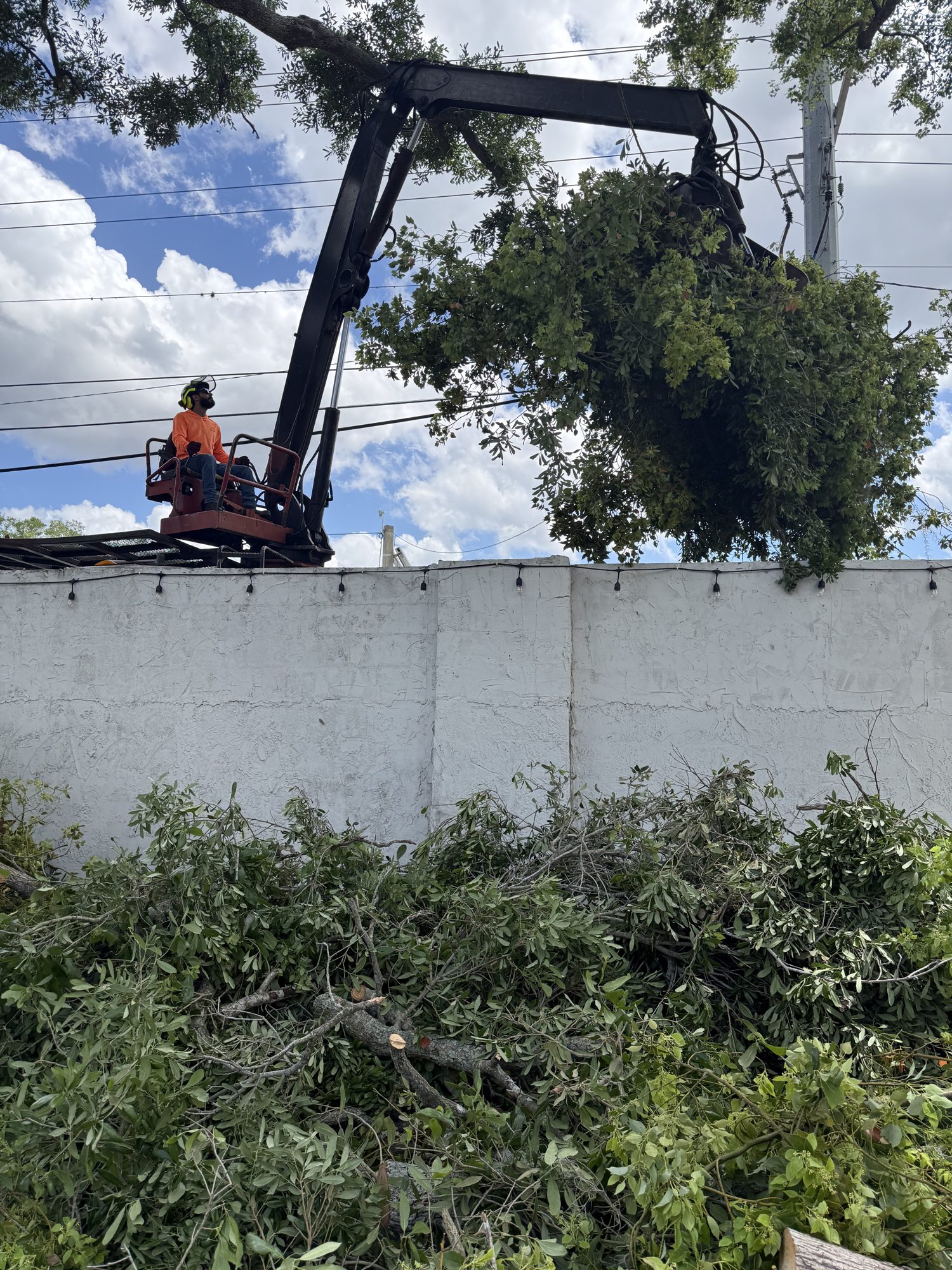
That's one of our operators running the grapple on a job where the brush was on one side of a tall stucco wall and the truck could only reach the other, with power lines strung right across the work area. The pile at the bottom of the frame is canopy, already cut and lying on the ground. There was no good way to carry it out through a gate, and no reason to try. The grapple reaches over the wall, closes on a load that would take a lot of trips by hand, and swings it out to the truck without dragging anything across the wall or into the lines.
That's what the grapple truck is really for. People think of it as a faster way to haul brush, and it is. But on a tight property its bigger job is keeping heavy wood off the lawn, out of the landscaping, and away from the side gate everyone else would have dragged it through.
Protecting the ground itself
Lawns get destroyed by weight, not by trees. A loaded truck or a stump grinder rolling across wet St. Augustine leaves ruts you'll still be looking at next spring. Our approach is simple: work from the street or the driveway whenever the reach allows, put plywood down under heavy equipment when it has to cross grass, and use tracked machines where the ground is soft. If a yard is saturated after a week of rain, sometimes the right call is to wait a day or two. We'll say so.
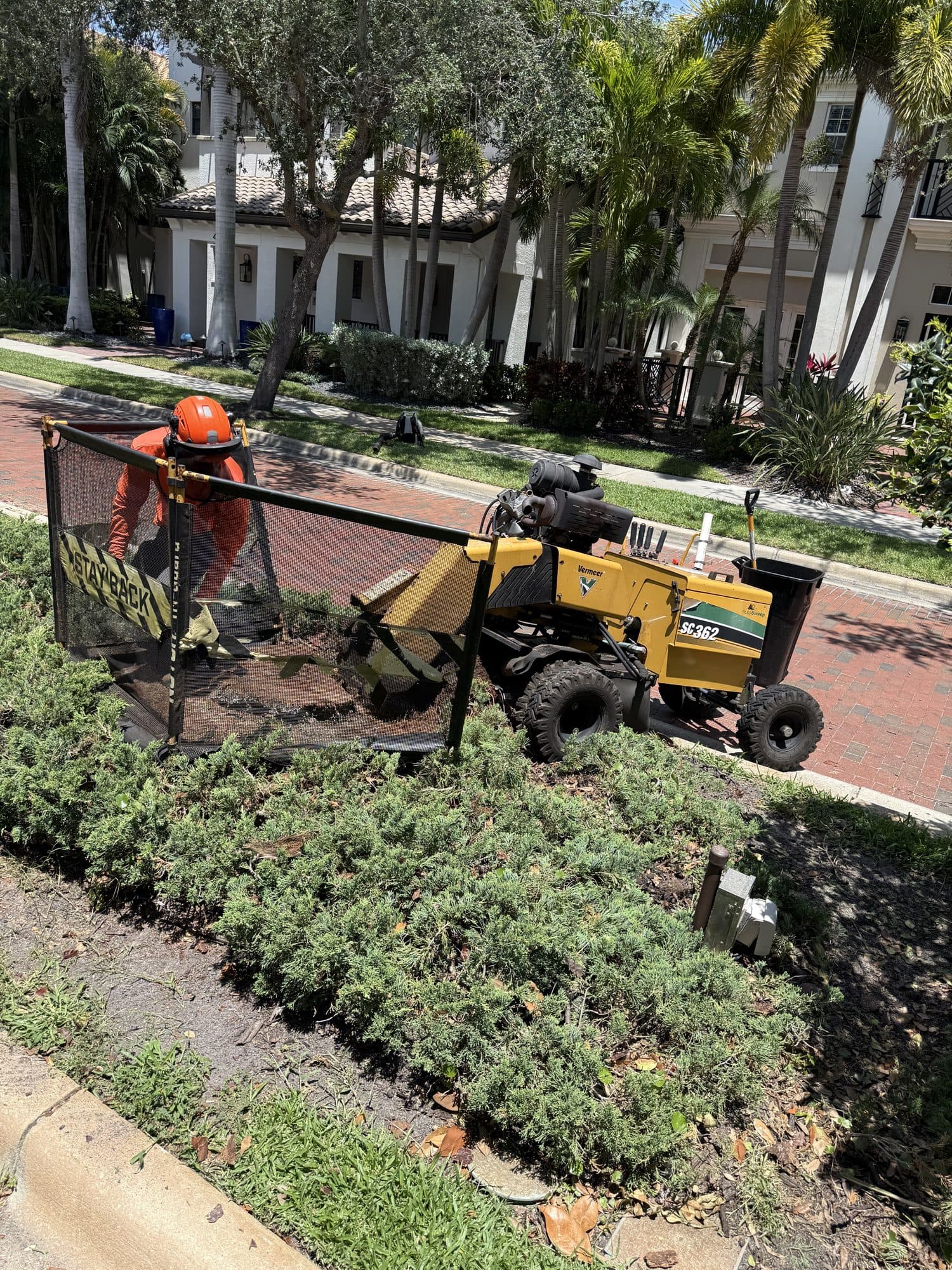
Stump grinding has its own hazard: the grinder throws chips hard, and they don't care what's in the way. In the photo at the top of this post, the stump sits in a planting bed a few feet from a brick street and the sidewalk. The black mesh screen with the "STAY BACK" banner is a debris net, set up around the cutting wheel so the chips hit the net instead of a windshield or a front window. The junipers around it and the landscape lighting in that bed stayed right where they were. That's the other half of the job, working around everything that was there before we arrived.
When something does go wrong
Tree work means heavy wood and moving machines, and on a long enough timeline something gets scuffed or cracked. What matters is what happens next. If we damage something, we tell you the same day and we make it right. That's exactly what our liability insurance is for.
It's also the honest reason to ask any company for its certificate of insurance before the work starts. When an uninsured crew cracks a fence or a water line, the repair usually comes out of your pocket, not theirs. We wrote more about checking that in How to Find a Reliable Local Tree Service in Tampa Bay.
What you can do before we show up
Move the cars out of the driveway and off the street in front. Unlock the gates. Bring the pets inside. Take down anything hanging in the tree, like a swing or a bird feeder, and point out whatever is buried or hidden in the yard. That's the whole list. Everything else is our job.
Get a plan for your tree
We'll come out, walk the property with you, explain exactly how the job would be done and where everything would go, and put the price in writing. Free, in person, anywhere we serve: Lutz, Tampa, Carrollwood, Westchase, Wesley Chapel, Land O' Lakes, Odessa and the rest of Tampa Bay.
Call (813) 751-5732 for an estimate, or (813) 244-0050 for removals and storm work, answered 24/7.