What Makes a Good Tree Service Company? The Things You Won't See in the Quote
2026-10-15
We've already written about checking insurance, comparing quotes and spotting fake reviews. Those are the paperwork tests, and they matter. But a company can pass all of them and still do bad work in your yard. What separates a good tree service from an average one mostly happens in decisions you never see: what the estimator says when you ask about a tree, where the climber puts his spikes, and how the crew acts the week after a hurricane.
Here's what those decisions look like from our side of the truck.
It starts with the word "no"
The most useful thing a tree company can tell you is sometimes "don't touch that tree." We say it a lot. A big live oak in Carrollwood with a sound trunk and a clean root flare usually needs a thinning and some deadwood taken out, not removal. A sabal palm with a full green crown needs the seed stalks and dead fronds cut, and that's all.
A company that makes its money by the ton will find a reason to cut everything. A good one gives you the cheaper answer when the cheaper answer is the right one, because it's trying to keep you as a customer for twenty years instead of one job. If every tree on your property "has to go," get a second opinion.
The opposite matters just as much. Laurel oaks around Lutz and Lake Magdalene are reaching the end of their lifespan in a lot of older neighborhoods. When one has a hollow base or a split union over a bedroom, a good company says so plainly, even though you didn't want to hear it.
The cuts tell you who you hired
You can judge a crew by what it leaves behind. Here's what we look for when we walk a yard another company trimmed last year:
- Topped trees. Big limbs cut back to stubs in the middle of the canopy. It looks tidy for a few months, then the tree throws out a mess of fast, weakly attached sprouts that break off in the next tropical storm. Nobody who knows trees does this, whatever they call it.
- Flush cuts and torn bark. A proper cut sits just outside the branch collar so the tree can seal it over. Cut flush to the trunk, or let a heavy limb peel bark down the stem, and you've opened a door for decay.
- Spike marks on a tree that was supposed to stay. Climbing spikes are fine on a removal. On a tree you're keeping, they punch holes up the trunk. Our climbers use ropes and the bucket truck on trimming jobs.
- Palms with only a few fronds left on top. Over-trimmed sabal palms are weaker in wind and slower to recover. If the green fronds above horizontal are gone, the palm was cut for looks, not health.
- Lion-tailing. All the interior growth stripped out and leaves left only at the tips. It concentrates weight at the end of the limb, which is the last place you want it in a September gust.
None of these will show up on an invoice. They show up two or three years later.
The right machine, and someone who knows when to call it
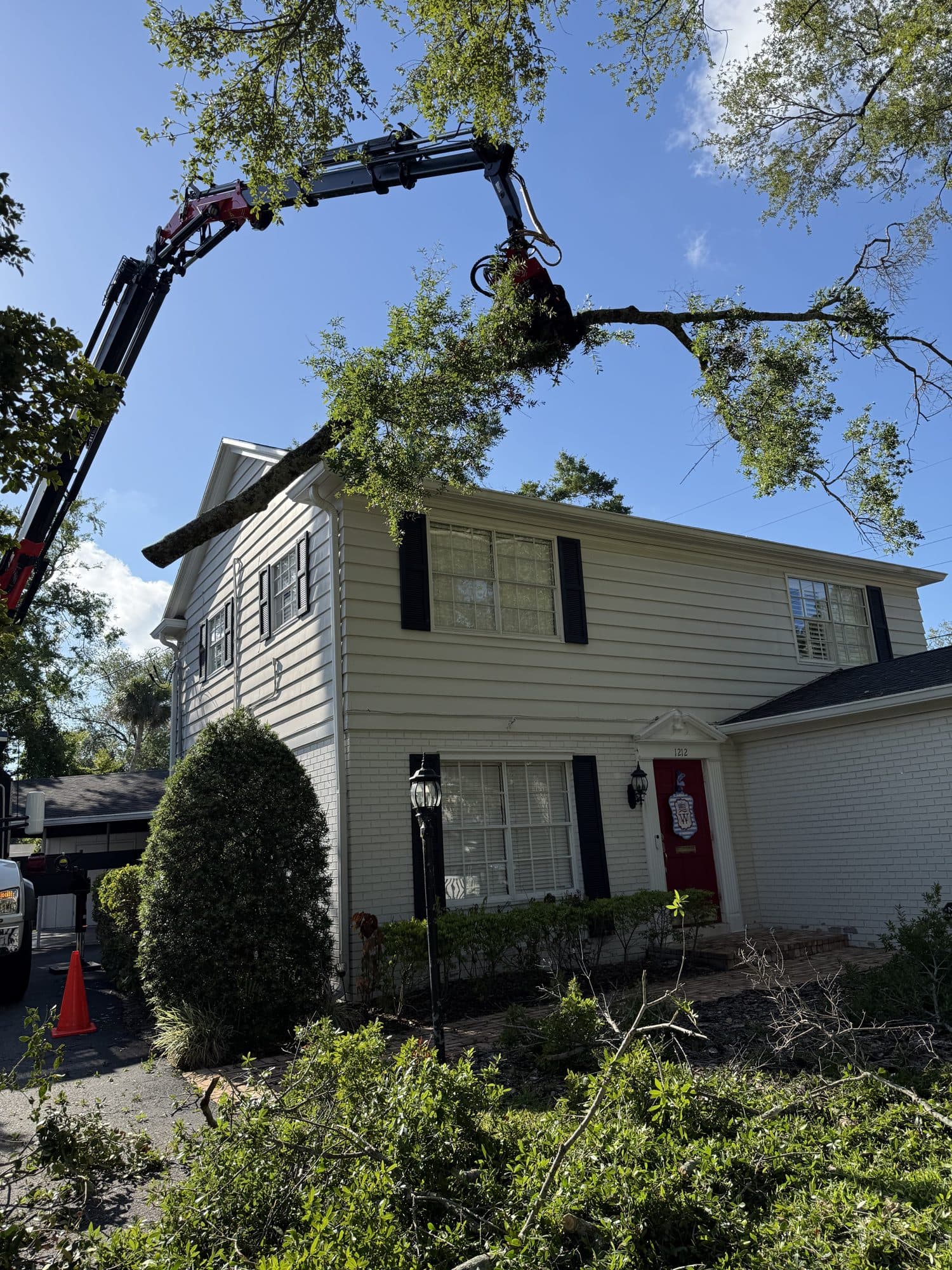
The photo at the top is one of our crane jobs: a tree with a house under it, where nothing could just be dropped. On a job like that, the work that matters happens before the saw starts. Someone has to decide where the crane sets up, how much each pick weighs, what the ground can carry, and where every piece lands. Get any of that wrong and the crane becomes the hazard.
Equipment isn't about owning the biggest machines. It's about matching the method to the yard. Some trees come down in big pieces with a crane. Some get rigged down piece by piece by a climber on ropes. Some get dropped in one fell because there's open ground and no reason to spend your money on anything fancier. Our grapple truck can reach over a fence to lift logs out without dragging them across a lawn. A stump grinder needs screens or nets around it when there's a pool cage or a car nearby.
A company with only one tool solves every job with that tool. Ask how they plan to take the tree down and why. A good crew will have an answer before you finish the question.
How they act when everyone needs them
We worked through Helene and Milton back to back, and those weeks show you who's who in this business. Trucks with out-of-state plates were going door to door in Hillsborough and Pasco, asking for big deposits up front, quoting whatever the panic would pay and sometimes disappearing halfway through the job.
A good local company in a storm week sorts its calls by danger: trees on occupied houses and blocked driveways first, then everything else. It tells you honestly when it can get to you, even if the answer is "Thursday." It doesn't charge you a hurricane price for a tree that's been lying in the side yard for a week. And it's still around in February when you call about the stump.
That last point gets overlooked. A Tampa Bay tree company lives on its reputation in Wesley Chapel, Northdale and Westchase, among people who talk to their neighbors. Out-of-state crews leave after the storm. A local company has to keep facing those neighbors.
What we'd tell a friend
If you only have time to check a few things, do these:
- Ask what they'd leave alone. A company that recommends less than you expected is usually one you can trust with more.
- Look at a yard they trimmed a year or two ago. Check for stubs, flush cuts and bald palms.
- Ask how the tree is coming down and where the pieces go. Listen for a real plan with real equipment, not "we'll take care of it."
- Notice who shows up for the estimate. It should be someone who knows trees, not just a salesman with a clipboard.
- Find out whether they'll still be here in a year. Look for a local address, local phone numbers and work you can drive past.
Come see how we work
We'll walk your property for free, tell you which trees need work and which don't, and put the price in writing. Sometimes that walk ends with "you're fine." Call (813) 751-5732 or request an estimate. If a tree is already down, call our emergency line at (813) 244-0050, any hour. We serve Lutz, Carrollwood, Wesley Chapel, Tampa and the rest of Tampa Bay.